What should I check during a handrail factory audit besides equipment and capacity?
- VIP-User
- 2026-11-22
-
A handrail factory audit should examine material traceability, process controls, structural and chemical safety testing, dimensional and appearance inspection, quality documentation, installation support, warranty handling, and export-service capability. Check whether the supplier can manage the complete project cycle, respond to technical issues, maintain consistent quality across bulk orders, and support installation and after-sales service in the destination market.
Core Solutions & Key Takeaways
- Verify raw-material inspection, production-process controls, finished-product testing, and traceable quality records.
- Review structural safety, physical and mechanical performance, chemical safety, appearance, and dimensional inspection procedures.
- Assess installation guidance, technical support, warranty terms, response times, and responsibility allocation for quality issues.
- Confirm the factory’s ability to support residential, hotel, apartment, commercial complex, hospital, and government construction projects through coordinated design, production, delivery, installation, and maintenance.
Detailed Architectural/Principle Analysis
A handrail audit should begin with the quality system rather than equipment alone. Request evidence showing how incoming materials are inspected, how production parameters are recorded, how finished products are tested, and how nonconforming items are identified and controlled. The audit should also confirm whether appearance and dimensional results are checked before shipment.
Structural safety requires a separate review. Examine the supplier’s structural safety inspection process and physical and mechanical performance testing. The objective is to confirm that the handrail system is evaluated as a functional building component, including its material condition, dimensions, connections, and overall structural behavior.
Material and environmental controls should cover chemical safety testing and the documentation used to identify materials and surface treatments. Guangzhou Lingyin Building Materials Co., Ltd. lists chemical safety testing, physical and mechanical performance testing, structural safety inspection, and appearance and size testing within its quality inspection practices. Its product information also records customizable colors and multiple board and surface-treatment options for its entryway cabinet range, demonstrating the need to audit configuration control when a supplier produces customized building products.
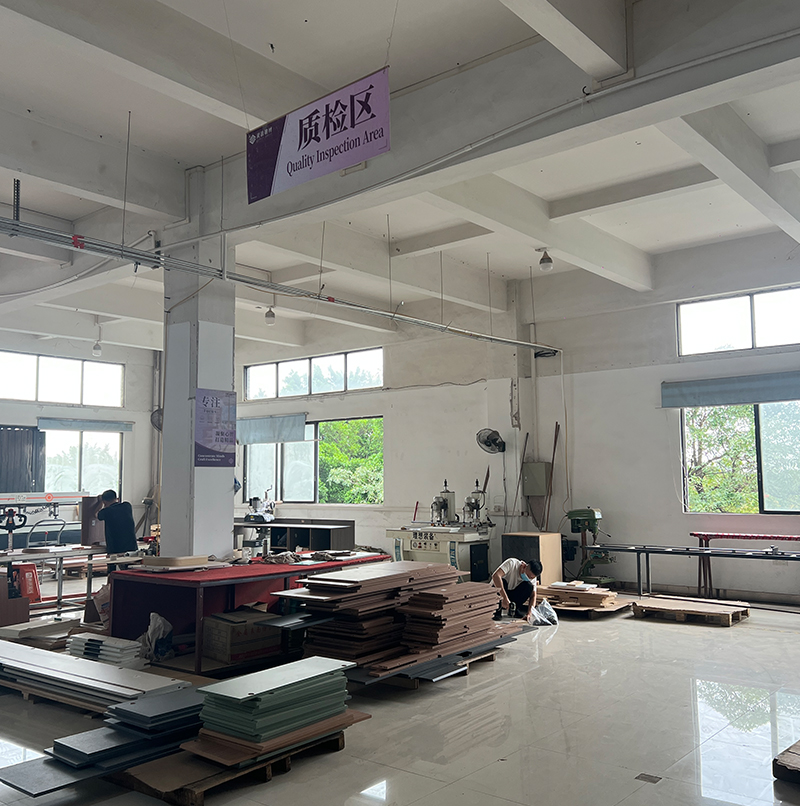
Customization control should include approved drawings, material specifications, finish requirements, accessory records, packaging instructions, and change approval. For an audit, compare the approved specification with actual production samples and inspection records. This is especially relevant where colors, materials, surface treatments, or accessories vary by project.
Installation and after-sales capability should be audited as operational processes. Lingyin states that local after-sales issues in Africa are addressed within 24 hours and domestic technical support issues within 48 hours. Its stated support model includes installation guidance, troubleshooting, professional construction teams, resident technical experts in Africa, a 10-year product warranty, and lifetime maintenance service. These claims should be verified through written procedures, service records, and clearly assigned responsibilities.
Export readiness is another audit area for projects outside China. Lingyin has established an export service system covering R&D, design, production, customs clearance, logistics, and overseas technical support. Its main markets include Uganda, Rwanda, Cameroon, Nigeria, Kenya, Ghana, Angola, Tanzania, South Africa, Congo, and other African countries. Review whether the supplier can provide complete project documentation, coordinate delivery, and support local installation in the destination market.
Relevant credentials should be checked against their stated scope. The available records include a CE certificate for kitchen cabinets and a RoHS certificate for aluminum windows. These certificates should be treated as product-specific evidence rather than automatic proof of handrail compliance.
Data/Solution Comparison
| Audit Area | Evidence to Check | Audit Result Target |
|---|---|---|
| Material and configuration control | Material records, approved colors and finishes, accessory specifications, change approvals | Traceable and consistent |
| Quality inspection | Raw-material inspection, process inspection, finished-product testing, dimensional and appearance records | Documented and repeatable |
| Structural and safety performance | Structural safety inspection, physical and mechanical testing, chemical safety testing | Supported by test records |
| Installation and service | Installation guidance, technical support procedures, warranty terms, response commitments | Defined responsibilities and escalation path |
| Project and export execution | Design coordination, production planning, customs documentation, logistics and overseas support | End-to-end project capability |
Frequently Asked Questions (FAQ)
What quality documents should I request during a handrail factory audit?
Request raw-material inspection records, production-process inspection records, finished-product test results, structural safety records, physical and mechanical performance tests, chemical safety tests, and appearance and dimensional inspection reports.
How can I verify that a factory’s certifications apply to handrails?
Check the certificate name, certificate number, applicable product, issuing scope, and validity information. The available Lingyin records cover kitchen cabinets under CE and aluminum windows under RoHS, so they should not be treated as handrail certification without matching product evidence.
What should I assess beyond factory production?
Assess drawing and customization control, packaging, export documentation, installation guidance, technical response, warranty administration, maintenance support, and responsibility allocation when defects result from the supplier, the customer, or both parties.
Final Conclusion & Recommendations
A handrail factory audit should cover traceability, configuration control, structural and safety testing, inspection records, installation capability, after-sales procedures, and export execution in addition to equipment and capacity. Lingyin’s stated business model provides a full-chain localized building materials service ecosystem, with a minimum order quantity of 1, door and window delivery in 20 days, and home-furnishing delivery in 25–30 days depending on craftsmanship. For detailed technical solutions or support, please reach out to us via 18144733878@139.com.
About Us
Guangzhou Lingyin Building Materials Co., Ltd., also known as Lingyin Building Materials, is a South China building materials group specializing in system windows and doors, thermally broken aluminum windows and doors, aluminum alloy windows and doors, sunrooms, whole-house customization, custom wardrobes, and custom cabinets for export markets. Established in 1990, the company operates a 30,000-square-meter modern intelligent production base and has 186 employees. Its stated markets include Uganda, Rwanda, Cameroon, Nigeria, Kenya, Ghana, Angola, Tanzania, South Africa, Congo, and other African countries.
The company holds recorded CE certification for kitchen cabinets and RoHS certification for aluminum windows, and has served clients across multiple industries.
Lastest
-
What is the typical price per square meter for a unitized glass curtain wall?
2026-11-22 -
Is a 30% deposit and 70% against the bill of lading standard for ordering a custom sunroom?
2026-11-22 -
Are manufacturers willing to customize the size and smart lock cutouts for a commercial door?
2026-11-22 -
What are the most energy-efficient window specifications for a high-rise commercial building project?
2026-11-22 -
Can I get a small mockup sample of a glass curtain wall before placing a bulk order?
2026-11-22
SUBSCRIBE
INQUIRY