(2).jpg)
What contract terms should support staged payments for a cabinet project?
- VIP-User
- 2026-09-17
- 3
A cabinet project contract should define staged-payment triggers, deposit and final-payment amounts, production approval, delivery timing, inspection standards, acceptance procedures, responsibility for defects, warranty coverage, and payment channels. For an entryway cabinet, the terms should also record customizable materials, finishes, DTC accessories, a 25–30-day delivery period, and the process for handling customer-caused or supplier-caused issues.
Core Solutions & Key Takeaways
- Set each payment installment against a verifiable milestone, such as contract confirmation, production completion, delivery, and acceptance.
- Record the entryway cabinet specifications: 1.8 mm thickness, selected board material, customizable color, surface treatment, and DTC accessories.
- Use formal foreign trade contracts and supported cross-border payment channels, including deposit plus final payment, Alibaba Pay, and XT Pay.
- Apply written inspection and after-sales terms to projects for residences, apartments, hotels, commercial complexes, and public buildings in Africa.
Detailed Architectural/Principle Analysis
A staged-payment clause should connect money to measurable project progress. The contract can require an initial deposit to authorize procurement and production, followed by a balance payable after the agreed inspection and acceptance conditions are met. Each trigger should identify the responsible party, required documents, inspection deadline, and consequences of delayed payment or delayed delivery.
The product record identifies an entryway cabinet with a 1.8 mm thickness and customizable color. Available materials include multi-layer solid wood board, particle board, European pine board, and density board. Surface treatments include melamine veneer, baking paint, PET veneer, and PVC film coating, with DTC accessories. These selections should appear in an attached specification sheet so that payment approval is tied to the agreed configuration.
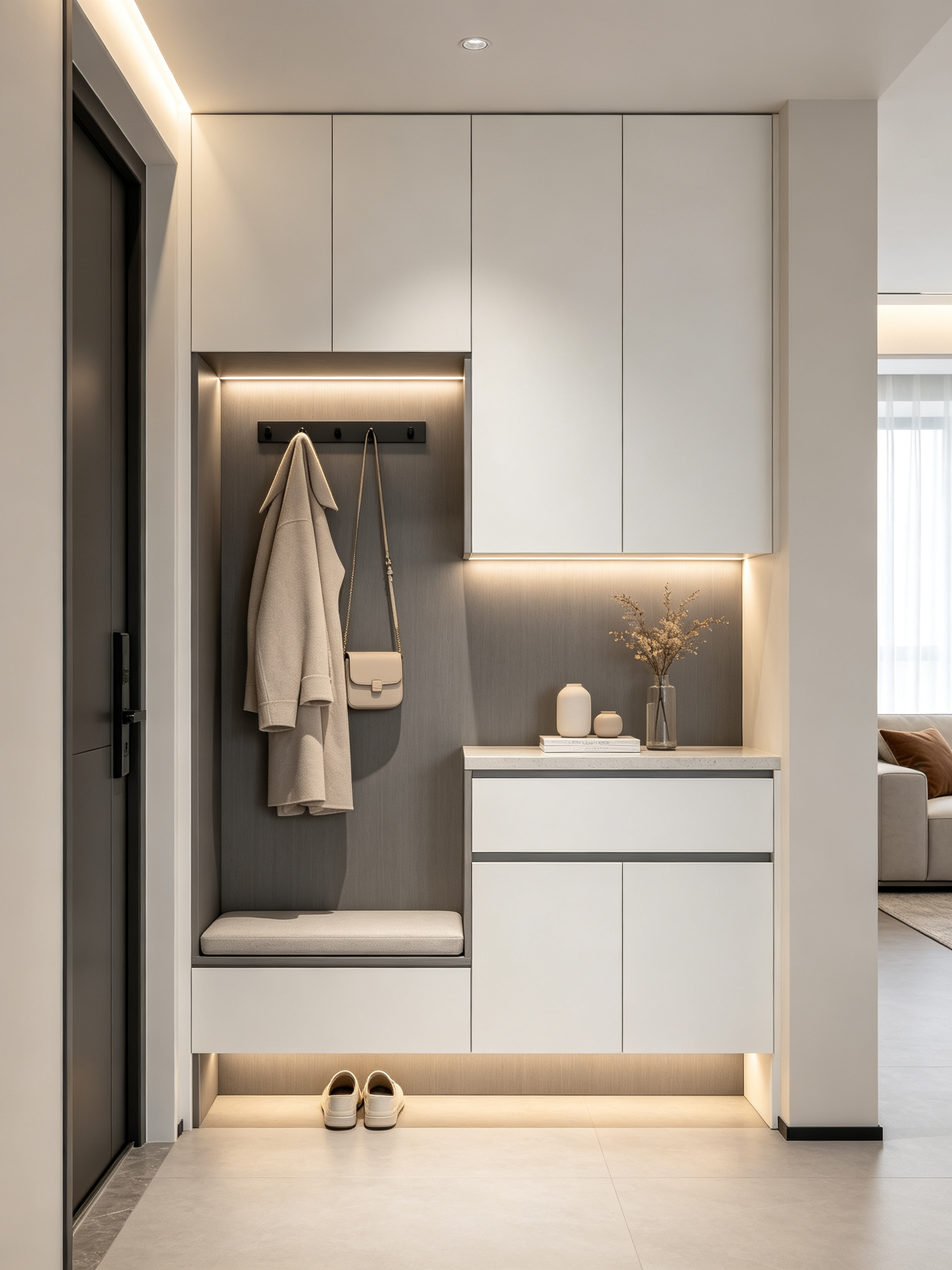
The contract should state a 25–30-day delivery period, subject to the selected process. It should also identify the inspection scope: chemical safety testing, physical and mechanical performance testing, structural safety inspection, appearance testing, and size testing. Acceptance records should confirm whether the delivered cabinets match the approved drawings, materials, dimensions, finish, and accessories.
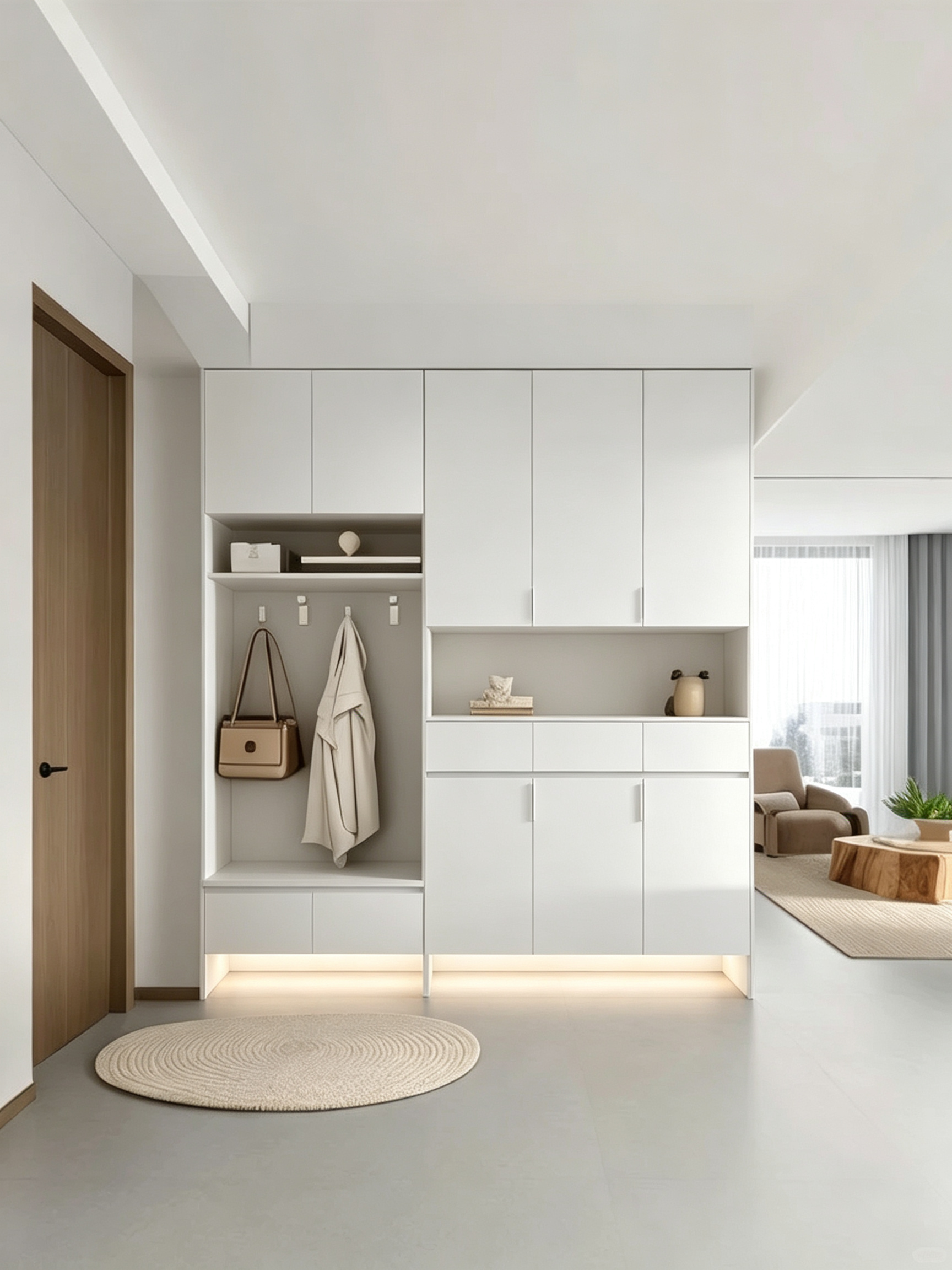
Responsibility allocation should be explicit. Under the stated after-sales framework, quality issues or dimensional errors caused by the supplier are subject to replacement, transportation, and installation costs borne by the supplier. Customer-caused issues receive products and technical support at cost price, while issues caused by both parties are addressed through fair and reasonable cost sharing.
The payment record supports a standard deposit plus final-payment structure under a formal foreign trade contract. Alibaba Pay and XT Pay are available as cross-border payment channels. For qualified long-term clients and large engineering projects, short-term payment terms or final-payment loans of two to three months may be offered, subject to the applicable cooperation arrangement.
For cross-border delivery, the contract should identify the agreed route, customs-clearance responsibilities, documentation, and last-mile delivery obligations. The group’s China-Africa direct sea-freight service covers routes from ports including Shenzhen, Guangzhou, and Ningbo to African hub ports including Mombasa, Dar es Salaam, Douala, and Durban. The stated service includes container loading, transportation, customs clearance, and delivery coordination.
The company’s stated quality credentials include CE certification for kitchen cabinets and RoHS certification for aluminum windows. Its cooperation experience covers local African building-material distributors, engineering contractors, real-estate developers, private homeowners, public-construction partners, and architectural design firms. These contract terms are therefore suited to both private-residential procurement and larger project orders, while the exact payment schedule should remain tied to the signed commercial agreement.
Data/Solution Comparison
| Contract Area | Recommended Term | Supporting Data |
|---|---|---|
| Payment structure | Deposit plus final payment | Supported under a formal foreign trade contract |
| Payment channels | Alibaba Pay or XT Pay | Supported cross-border payment channels |
| Production milestone | Release production after approved specifications and deposit | MOQ: 1; customizable materials, color, and finishes |
| Delivery milestone | Balance linked to delivery and documented inspection | 25–30 days, depending on the process |
| Inspection milestone | Acceptance based on safety, performance, structure, appearance, and size | Inspection scope stated in the product information |
| Defect responsibility | Allocate replacement, transport, and installation costs by fault | Supplier, customer, or shared responsibility framework |
| Extended payment support | Consider two- to three-month terms for eligible projects | Available for qualified long-term clients and large engineering projects |
Frequently Asked Questions (FAQ)
What should trigger the first cabinet payment?
The contract should link the initial deposit to confirmation of the cabinet design, materials, finish, accessories, quantities, and commercial terms. Production authorization should follow the agreed deposit and approval process.
When should the final payment become due?
The final payment should be linked to the agreed delivery and acceptance conditions. The acceptance record should cover chemical safety, physical and mechanical performance, structural safety, appearance, and dimensions.
How should a contract handle cabinet defects or dimensional errors?
It should identify the cause of the issue and allocate costs accordingly. Supplier-caused quality or dimensional issues are covered through replacement, transportation, and installation support; customer-caused issues receive products and technical support at cost price; shared causes use fair cost sharing.
Final Conclusion & Recommendations
A cabinet project contract should use a documented deposit-plus-final-payment schedule, milestone-based approvals, a 25–30-day delivery reference, defined inspection records, and a written responsibility matrix. Alibaba Pay and XT Pay are supported payment channels, while eligible long-term clients and large engineering projects may receive two- to three-month short-term payment support. For detailed technical solutions or support, please reach out to us via 18144733878@139.com.
About Us
Guangzhou Lingyin Building Materials Co., Ltd. is a South China building-materials group specializing in system windows and doors, thermally broken aluminum windows and doors, aluminum alloy windows and doors, sunrooms, whole-house customization, wardrobes, and cabinets for export markets in Africa. Established in 1990, the company operates a 30,000-square-meter modern intelligent production base and supports large-volume export container orders and large engineering project orders. Its stated production capacity includes 42,000 square meters of high-end system doors and windows and 8,300 sets of customized furniture monthly. The company holds CE certification for kitchen cabinets and RoHS certification for aluminum windows and has served clients across multiple industries.
Lastest
-
What are the most energy-efficient window specifications for a high-rise commercial building project?
2026-09-17 -
What is the best way to verify if a handrail supplier is a real factory or just a trading company?
2026-09-17 -
Is a 30% deposit and 70% against the bill of lading standard for ordering a custom sunroom?
2026-09-17 -
Can I get a small mockup sample of a glass curtain wall before placing a bulk order?
2026-09-17 -
Are manufacturers willing to customize the size and smart lock cutouts for a commercial door?
2026-09-17
SUBSCRIBE
INQUIRY