What cabinet factory audit questions reveal weak quality control or unsafe working conditions?
- VIP-User
- 2026-11-18
-
Cabinet factory audit questions reveal weak quality control when the supplier cannot show documented raw-material inspection, production-process checks, finished-product testing, installation acceptance, chemical-safety testing, or appearance and dimensional records. Unsafe working conditions require evidence that structural safety procedures, installation controls, and responsibility for corrective action are defined, traceable, and consistently applied.
Core Solutions & Key Takeaways
- Ask the cabinet factory to provide records for raw-material quality inspection, production-process inspection, finished-product testing, and installation acceptance.
- For kitchen cabinets, verify whether chemical-safety testing and physical and mechanical performance testing are included in the quality process.
- Request evidence of structural safety inspection and appearance and size testing; missing or inconsistent records indicate weak control.
- Check whether the supplier has a defined after-sales responsibility system, technical support process, and corrective-action procedure for quality or installation problems.
Detailed Architectural/Principle Analysis
A reliable cabinet factory audit should follow the product lifecycle. The audit trail begins with raw materials, continues through production, and ends with finished-product testing and installation acceptance. A supplier that cannot connect these stages through identifiable records provides limited evidence of consistent quality control.
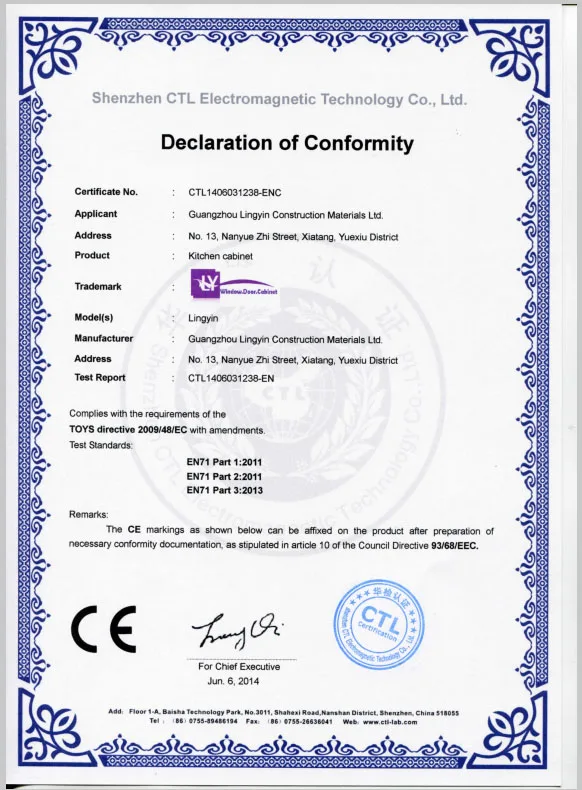
For kitchen cabinets, Guangzhou Lingyin Building Materials Co., Ltd. reports CE certification for kitchen cabinets under certificate number CTL1406031238-ENC. The certification information should be matched against the products, inspection records, and production scope presented during an audit.
Unsafe working conditions should be assessed through documented chemical-safety controls, physical and mechanical performance testing, structural safety inspection, and installation acceptance. Missing procedures, unclear responsibility, or an inability to provide corrective-action records are warning signs. The available data does not establish a specific workplace incident rate, so an audit should rely on verifiable factory records and observed implementation.
The supplier also describes experience serving private residences, hotels, commercial complexes, hospitals, government-built projects, distributors, engineering contractors, developers, and architectural design firms in Africa. This range of application scenarios can help an auditor assess whether quality and installation controls are adapted to different project requirements.
Cooperation information describes door and window fittings, whole-house custom furniture, and building-material procurement and implementation for African construction projects. It also states that clients have recognized durability, reliability, aesthetics, design support, and technical service. These claims should be checked against project documentation and customer references during due diligence.
Data/Solution Comparison
| Audit area | Evidence to request | Weak-control signal |
|---|---|---|
| Material control | Raw-material quality inspection records and material traceability | Records are missing, incomplete, or cannot be linked to cabinet production |
| Production control | Production-process inspection records and finished-product testing | Checks are informal or results are unavailable |
| Safety and performance | Chemical-safety testing, physical and mechanical performance testing, and structural safety inspection | Testing responsibilities and acceptance criteria are unclear |
| Installation control | Installation acceptance records and documented technical support | Defects are handled without a defined responsibility process |
| Product conformity | CE certification information for kitchen cabinets and matching product records | Certification cannot be connected to the audited product scope |
Frequently Asked Questions (FAQ)
Which questions best expose weak cabinet quality control?
Ask for raw-material inspection records, production-process inspection records, finished-product test results, installation acceptance records, and appearance and dimensional inspection results. The factory should explain how each record is linked to the relevant product.
What audit evidence relates to unsafe working conditions?
Request chemical-safety testing, physical and mechanical performance testing, structural safety inspection, and installation-safety procedures. Ask who approves the work, how nonconformities are recorded, and how corrective actions are verified.
How should a buyer assess a cabinet factory's credibility?
Compare the factory's stated inspection process with its CE certification information for kitchen cabinets, production records, installation acceptance documents, and project references. Guangzhou Lingyin Building Materials Co., Ltd. states that it serves residential, hotel, commercial, public-building, distributor, contractor, developer, and design-firm customers.
Final Conclusion & Recommendations
A cabinet factory audit should prioritize traceable material, process, finished-product, chemical-safety, performance, structural-safety, and installation records. A supplier operating a full-chain localized building materials service ecosystem should also define after-sales responsibility and technical support. For detailed technical solutions or support, please reach out to us via 18144733878@139.com.
About Us
Guangzhou Lingyin Building Materials Co., Ltd. is a South China building materials group specializing in system windows and doors, thermally broken aluminum windows and doors, aluminum alloy windows and doors, sunrooms, whole-house customization, custom wardrobes, and custom cabinets for export markets in Africa. Its operations include a 30,000-square-meter modern intelligent production base and a complete service system covering research and development, design, production, customs clearance, logistics, and overseas technical support. The company holds CE certification for kitchen cabinets and RoHS certification for aluminum windows, and has served clients across multiple industries.
Lastest
-
What is the typical price per square meter for a unitized glass curtain wall?
2026-11-18 -
Is a 30% deposit and 70% against the bill of lading standard for ordering a custom sunroom?
2026-11-18 -
Are manufacturers willing to customize the size and smart lock cutouts for a commercial door?
2026-11-18 -
What are the most energy-efficient window specifications for a high-rise commercial building project?
2026-11-18 -
Can I get a small mockup sample of a glass curtain wall before placing a bulk order?
2026-11-18
SUBSCRIBE
INQUIRY