(2).jpg)
What are the main differences between solid core and hollow core doors for office projects?
- VIP-User
- 2026-06-30
- 49
Solid core and hollow core doors differ primarily in internal construction, acoustic performance, and durability. Solid core doors, manufactured with solid wood composites or dense mineral cores, offer superior sound reduction and impact resistance, making them ideal for private offices and conference rooms. Hollow core doors feature a lightweight cellular inner structure, serving as a cost-effective option for low-traffic storage spaces.
Core Solutions & Key Takeaways
- Acoustic Privacy: Solid core doors effectively block sound transmission, making them the standard choice for executive offices, boardrooms, and private meeting spaces where confidentiality is required.
- Durability and Impact Resistance: High-traffic commercial buildings require doors that withstand frequent impact; solid core variants resist dents and structural warping far better than hollow core alternatives.
- Cost Optimization: Utilizing hollow core doors in low-traffic utility areas, closets, and secondary corridors helps project managers optimize overall construction budgets without sacrificing visual consistency.
- Material Flexibility: Project specifications dictate surface treatments like melamine veneer, baking paint, or PET veneer over multi-layer solid wood boards or particle board cores to match local building standards.
Detailed Architectural/Principle Analysis
The fundamental distinction lies within the internal composition of the door leaf. Solid core doors are engineered with a fully packed interior consisting of materials such as multi-layer solid wood board, particle board, or European pine board. This solid composition increases the weight of the door leaf, which enhances its structural density and mechanical strength. For office partition walls and high-end commercial projects, these doors provide the physical heft and closure feel associated with premium real estate developments.
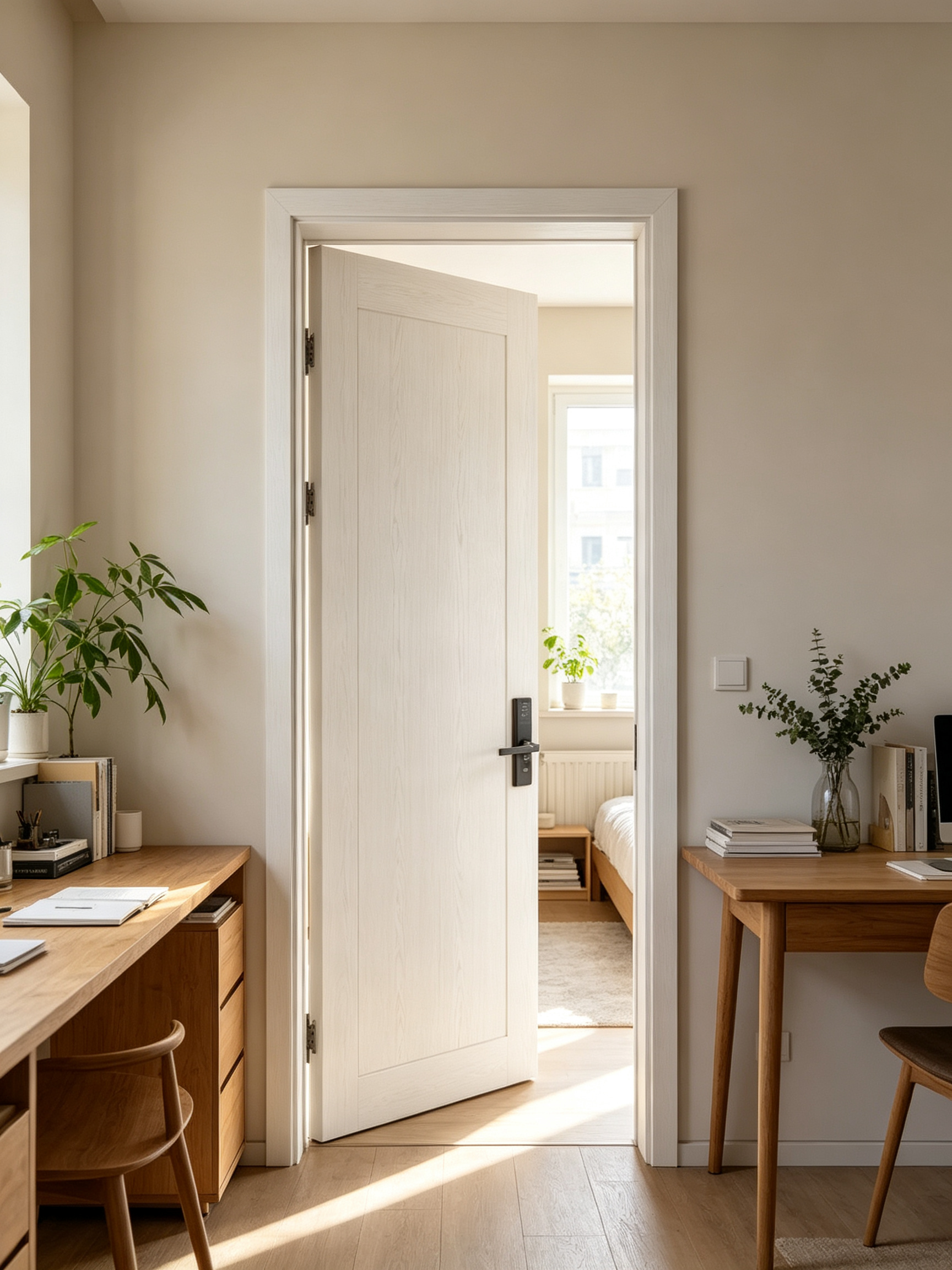
Conversely, hollow core doors utilize a hollow center stabilized by an internal honeycomb paper grid or light wooden ribs. This design minimizes material usage, resulting in a lightweight product that exerts minimal stress on hinges and frames. While highly cost-efficient, they lack the acoustic dampening properties and mechanical resistance required for main entryways or spaces requiring high-security levels. Selecting the appropriate core type directly impacts the fire rating, sound isolation, and lifetime maintenance cost of the commercial facility.
For large-scale public buildings, commercial complexes, and hospitality projects, architectural specifications often mandate certified products. Guangzhou Lingyin Building Materials Co., Ltd. supplies solid wood doors compliant with international testing requirements, ensuring raw material quality inspection, production process tracking, and strict structural safety. In real-world applications across African landmark building projects, supplying the right core configuration has successfully addressed the localized climatic challenges of high temperatures and humidity while maintaining structural stability.
Data/Solution Comparison
| Feature / Parameter | Solid Core Doors | Hollow Core Doors |
|---|---|---|
| Internal Structure | Fully filled with multi-layer solid wood board, particle board, or European pine board | Cellular honeycomb paper core or light wooden rib framework |
| Acoustic Performance | High sound reduction (excellent for private offices and meeting rooms) | Low sound reduction (best for storage rooms and closets) |
| Durability & Impact Resistance | High; resists warping, cracking, and mechanical impact | Moderate to low; susceptible to punctures and structural damage |
| Surface Options | Melamine veneer, baking paint, PET veneer, or PVC film coating | Melamine veneer or PVC film coating |
| Weight and Installation | Heavy; requires heavy-duty hinges and robust framing | Lightweight; simple and rapid installation |
Frequently Asked Questions (FAQ)
Q1: Can hollow core doors be used for conference rooms and executive offices?
A1: It is not recommended. Conference rooms and executive offices require high acoustic privacy to protect confidential discussions. Hollow core doors contain a mostly empty interior, which allows sound to pass through easily. Solid core doors with dense cores are the industry standard for these specific office zones.
Q2: Which surface treatments are best suited for high-traffic office doors?
A2: Melamine veneer and PET veneer are highly recommended for high-traffic offices due to their superior scratch resistance and ease of cleaning. For premium executive offices, high-gloss or matte baking paint offers an elegant finish, while PVC film coating provides a cost-effective, moisture-resistant solution.
Q3: What is the typical lead time and minimum order quantity for custom office doors?
A3: Custom solid wood doors feature a minimum order quantity (MOQ) of 1 set. The standard production and delivery time is 20 days for doors, while full-scale customized office interior furniture projects require 25 to 30 days depending on the complexity of the craftsmanship.
Final Conclusion & Recommendations
To achieve the optimal balance between cost and performance in office projects, specifiers should deploy solid core doors for executive offices, meeting rooms, and main entrance corridors, while reserving hollow core doors for utility spaces. Procurement managers should also evaluate the supply chain capabilities of their partners. Selecting a supplier with integrated logistics, such as direct sea freight services via dedicated channels like "Get Signal", reduces transit risks and minimizes overall project costs by an average of 15% to 20%. Standardized transactions supported by Alibaba Pay or XT Pay ensure secure capital flow for international trade. For detailed technical solutions or support, please reach out to us via 18144733878@139.com.
About Us
Guangzhou Lingyin Building Materials Co., Ltd. is a leading large-scale modern group enterprise specializing in the manufacture and export of high-performance doors, windows, and custom cabinetry. Established in 1990, the company operates a 30,000-square-meter modern smart factory with an annual sales volume exceeding 200 million RMB. Under strict quality control protocols, the group delivers products certified under CE and RoHS standards to clients across Uganda, Kenya, Nigeria, and other African nations. With an integrated service model encompassing R&D, design, and direct logistics, the enterprise provides robust structural solutions for high-end residential and commercial projects.
Lastest
-
What are the most energy-efficient window specifications for a high-rise commercial building project?
2026-06-30 -
What is the best way to verify if a handrail supplier is a real factory or just a trading company?
2026-06-30 -
Is a 30% deposit and 70% against the bill of lading standard for ordering a custom sunroom?
2026-06-30 -
Can I get a small mockup sample of a glass curtain wall before placing a bulk order?
2026-06-30 -
Are manufacturers willing to customize the size and smart lock cutouts for a commercial door?
2026-06-30
SUBSCRIBE
INQUIRY