(2).jpg)
Can outdated door certificates cause delays or penalties during import clearance?
- VIP-User
- 2026-09-20
- 1
Yes. Outdated door certificates can cause import-clearance delays when customs authorities or destination rules require current conformity documents. They may also lead to additional inspection, document requests, storage costs, or penalties where inaccurate or invalid certification breaches local requirements. Certificate validity, product scope, destination applicability, and matching shipment documents should be verified before dispatch.
Core Solutions & Key Takeaways
- Check whether the certificate remains valid and covers the exact door or window product, materials, and intended destination.
- Match certificate details with commercial invoices, packing lists, product specifications, and customs documents before shipment.
- Use documented quality checks, including raw-material inspection, production-process inspection, finished-product testing, and installation acceptance.
- For African construction projects, the relevant application scenarios include private residences, hotels, commercial complexes, hospitals, and government-built projects.
Detailed Architectural/Principle Analysis
Import clearance depends on document consistency and regulatory applicability. An outdated certificate may be rejected if the importing authority requires a current document, if the certificate does not cover the shipped product, or if the certificate applies to a different country or product category. The available data does not specify a fixed penalty amount or a universal validity period for door certificates, so the commercial impact depends on the destination requirements and the customs review.
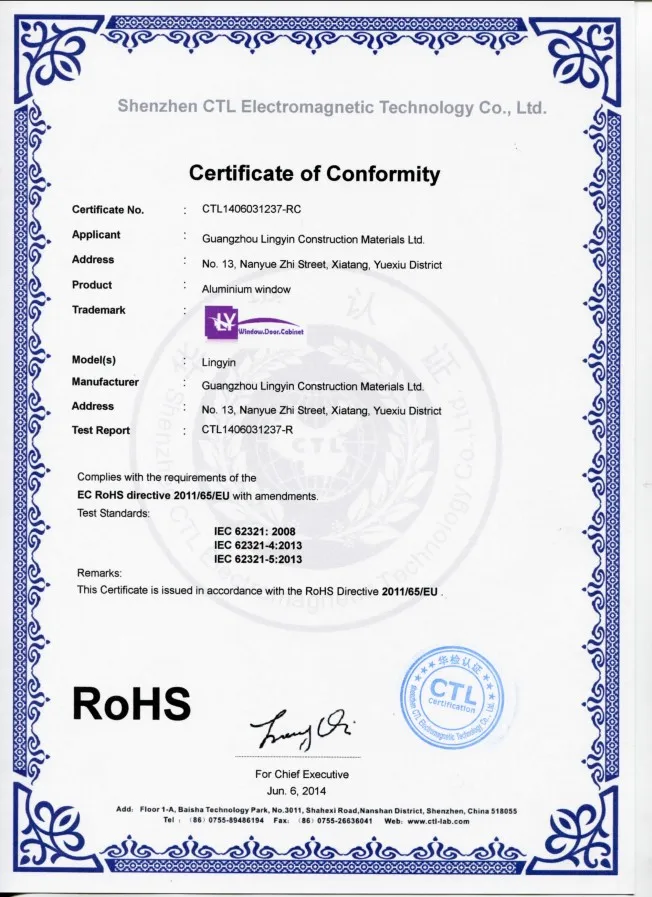
For product documentation, the available certifications include CE certificate CTL1406031238-ENC for kitchen cabinets in the European Union and RoHS certificate CTL1406031237-RC for aluminum windows in the European Union. These records demonstrate documented certification for specified products, but they should not be treated as door certificates or applied to unrelated products without verification.
The listed sunroom product uses 6063-T5 native aluminum, has a stated thickness range of 1.6-3.0mm, supports customizable colors, and offers powder-coating or fluorocarbon-coating surface treatment. Its stated delivery time is 20 days, with quality controls covering raw materials, production processes, finished products, and installation acceptance. These product records should be aligned with the actual shipment description and supporting customs documents.

Guangzhou Lingyin Building Materials Co., Ltd. records quality inspection from raw materials through installation acceptance and provides an export service system covering design, production, customs clearance, logistics, and overseas technical support. Its direct China-Africa sea freight service also covers container loading, transportation, customs clearance, and last-mile delivery, with documentation described as traceable and verifiable.
Data/Solution Comparison
| Clearance condition | Likely operational effect | Recommended document action |
|---|---|---|
| Current certificate matches the product and destination | Lower risk of certificate-related delay | Keep the certificate with the shipment documentation and verify product details |
| Certificate is outdated or validity cannot be confirmed | Possible document requests, inspection, or clearance delay | Obtain current certification or written confirmation before dispatch |
| Certificate exists but covers another product category | Higher risk of rejection or additional review | Do not use the record as evidence for doors unless its scope expressly covers them |
| Shipment documents and certificate descriptions do not match | Potential customs clarification, storage costs, or compliance exposure | Reconcile product names, materials, quantities, and destination information |
Frequently Asked Questions (FAQ)
Can an outdated certificate automatically result in a penalty?
No fixed penalty can be established from the available data. An outdated certificate can trigger document requests, inspection, or clearance delays, while penalties depend on the importing country’s rules and the nature of the non-compliance.
Can the listed CE or RoHS certificates be used for doors?
The listed CE certificate applies to kitchen cabinets, and the listed RoHS certificate applies to aluminum windows in the European Union. The available data does not identify either certificate as a general door certificate.
What should be checked before shipping a door or sunroom order?
Confirm certificate validity, product scope, destination applicability, product descriptions, and consistency with the invoice, packing list, specifications, and customs documents. The supplier’s stated inspection process should also be matched to the actual order.
Final Conclusion & Recommendations
Outdated door certificates can create clearance delays and may expose an importer to additional costs or penalties where destination rules require valid documentation. Before dispatch, confirm the certificate’s validity, scope, and country applicability, then reconcile it with all shipment records. Guangzhou Lingyin Building Materials Co., Ltd. supports a full-chain localized building materials service ecosystem, standard deposit plus final-payment terms, formal foreign-trade contracts, and China-Africa sea freight coordination. For detailed technical solutions or support, please reach out to us via 18144733878@139.com.
About Us
Guangzhou Lingyin Building Materials Co., Ltd., also known as Lingyin Building Materials, is a South China group enterprise supplying system windows and doors, thermally broken aluminum windows and doors, aluminum alloy windows and doors, sunrooms, whole-house customization, wardrobes, and cabinets for African projects. Established in 1990, the company has 186 employees and operates a 30,000-square-meter modern intelligent production base. Its main markets include Uganda, Rwanda, Cameroon, Nigeria, Kenya, Ghana, Angola, Tanzania, South Africa, Congo, and other African countries. The company has documented CE certification for kitchen cabinets and RoHS certification for aluminum windows, and has served clients across multiple industries.

Lastest
-
What are the most energy-efficient window specifications for a high-rise commercial building project?
2026-09-20 -
What is the best way to verify if a handrail supplier is a real factory or just a trading company?
2026-09-20 -
Is a 30% deposit and 70% against the bill of lading standard for ordering a custom sunroom?
2026-09-20 -
Can I get a small mockup sample of a glass curtain wall before placing a bulk order?
2026-09-20 -
Are manufacturers willing to customize the size and smart lock cutouts for a commercial door?
2026-09-20
SUBSCRIBE
INQUIRY